


Free cam access sounds simple, yet four platforms I trialled side by side in October 2023 showed how different the same word can be. On one site, free meant a full public room with chat. On another, it meant a blurred thumbnail and a registration wall. This comparison covers what you actually receive without paying, what is locked, and how to judge whether the paid tier is worth 9.99 to 29.99 GBP per month.
What Free Access Usually Includes
Across the platforms I checked, the free layer is consistent. You can browse the performer grid, open public rooms and read the open chat. Search filters for category, language and region normally work without an account. Streams run in standard definition, typically 480p, and many rooms cap the frame rate when traffic is high.
Registration is free on most sites and takes an email address and password. Cumlouder follows the same pattern: you confirm the account through an email link, and payment details are only requested when you move to a paid membership. The site also offers free videos alongside its paid features, so the line between free and premium is easy to see before you spend anything.
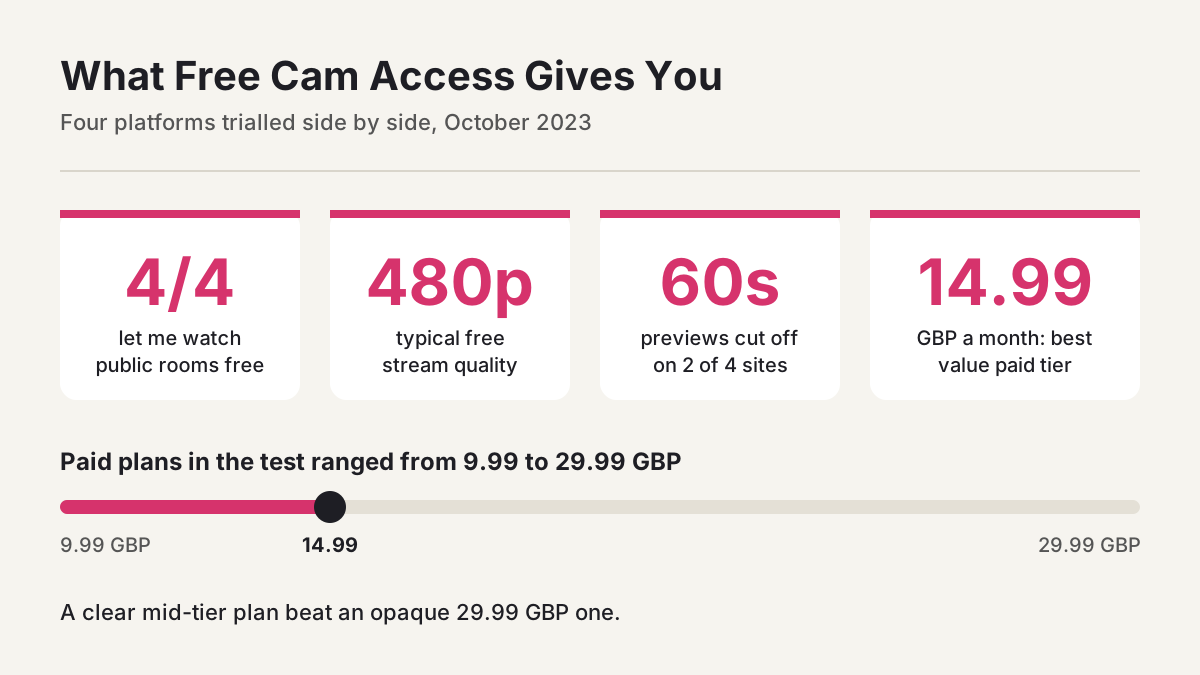
Data from my trial is worth stating plainly. Of the four platforms, all four let me watch public rooms without paying, but only one let me use chat without a verified email. Two showed full-length previews, and two cut previews after about 60 seconds. If you want to understand the practical gap, our guide to Cumlouder free vs premium lays out the same split for one platform in detail.
What Stays Locked Behind a Paywall
Private and exclusive shows are the clearest paywall. They run on tokens or credits, and the per-minute rate is set by the performer or the site, so the price varies widely between rooms. HD streams, saved favourites, message history and ad-free browsing also tend to move behind a subscription.

Token systems deserve a closer look. You buy a bundle, then tip or pay for private time in tokens. The performer receives a fixed payout per token, commonly in the region of 50 to 70 percent of the value, and the site keeps the rest. Tokens have no value outside the platform, and some sites expire them after a period of inactivity. If you plan to buy, read how Cumlouder credits work before you deposit.
Anything that touches identity also sits behind the wall. Account recovery, saved payment methods and some chat functions require verification, and our page on Cumlouder verification explains what the age check involves.
The Real Cost of Free: Tips, Ads and Pressure
Free is rarely silent. Public rooms run on tipping, so you will see goal bars, tip menus and repeated prompts asking you to spend tokens. In my trial, one platform showed a tip prompt roughly every two minutes in popular rooms. Skip them, and the stream carries on, but the experience is built to nudge you.
Advertising adds another layer. Free tiers often carry banner ads, pop-unders and promotional overlays. These are a bigger problem on lesser-known sites, where redirects can lead to unrelated offers. Treat any site that demands a download or browser extension to watch free streams as a red flag.
Chargebacks are the hidden cost on the paid side. If a viewer disputes a token purchase, the performer can lose earnings, and platforms respond with stricter checks. That is one reason free browsing stays open while spending stays tightly controlled.
My Benchmark: What 14.99 GBP Actually Buys
In October 2023 I compared premium subscriptions priced between 9.99 and 29.99 GBP per month, signing up for trials on four platforms at the same time. I wanted to test delivery against the marketing copy rather than trust the sales pages. The results were clear. Mid-tier plans at about 14.99 GBP gave the best balance of HD stream quality, private show access and performer variety, while the cheapest tier often unlocked little beyond ad removal.
The sharpest difference was transparency. Platforms that spelled out what each tier unlocked scored higher in my benchmark, whatever the price. Those that buried features behind vague upgrade prompts scored lower, and two of them left me unsure what I had paid for after the first week. Paying more did not fix an unclear plan, and a clear 14.99 GBP tier beat an opaque 29.99 GBP one.
Privacy and Safety on Free Accounts
Free does not mean anonymous. Registering hands over an email address, and the site logs your IP address and viewing activity. Check the privacy policy for how long data is kept and whether it is shared with advertisers. Reputable operators publish a contact for data requests, which is the standard you should expect under UK data protection rules.
Age checks are now routine. Sites ask you to confirm your birth year on entry, and some request more evidence for paid features. Platforms that skip any age gate entirely are worth avoiding, since it signals weak compliance elsewhere. Use a unique password, switch on two-factor authentication where offered, and never enter card details on a page that lacks a visible secure connection.
Payment security matters most when you move from free to paid. Prefer platforms that work with established billing processors and give a clear cancellation route. Cumlouder lists its billing partners and a cancel page, which is the kind of transparency worth looking for. If you want the full picture for that platform, read the Cumlouder review.
Where Free Falls Short and Paid Pulls Ahead
Free access has real limits, and it is fair to name them. Stream quality drops during busy hours, favourites do not save reliably, and search results lean towards performers who pay for visibility. Free users also sit at the back of the queue for private chat. If you watch more than a couple of hours a week, those frictions add up faster than the subscription cost.
The opposite is also true. If you browse occasionally, a free account is enough, and paying 14.99 GBP a month for a few evenings of viewing is poor value. Match the plan to your habit. A simple test is to track your viewing for two weeks: under three sessions, stay free; over six, a mid-tier plan likely pays for itself in comfort alone.
Sister platforms follow similar rules. GirlsWay runs a comparable split between open browsing and paid content, which makes it a useful second reference point when you compare how much each operator keeps behind the wall.
How to Compare Free Tiers Yourself
Open three sites in separate tabs and run the same checklist on each. Note the stream resolution, count the tip prompts in ten minutes, and see whether chat works without verification. Check that the pricing page lists what each tier unlocks, and read the cancellation terms before you enter a card. Ten minutes per site gives you enough data to rank them. Set up your login first through the Cumlouder account guide if you want to test a full registration flow.
Keep notes in a simple table of resolution, prompts, ads and signup friction. After three sites, patterns appear quickly, and the weakest option is usually obvious by the second tab. Free tiers are a fair way to test a platform, provided you treat the tipping prompts as sales copy and keep your spending decisions separate from the viewing.
Comments
No comments yet.
Leave a comment
Your email will not be shown. Comments are reviewed before they appear.